About Me

My photo
Portland, Oregon, United States
Co-founder, co-editor of Gobshite Quarterly and Reprobate/GobQ Books

Monday, July 18, 2011

The Virtues of Gender

Sometime last week? this week? somewhere on the web (see goodreads) Stephen King said "Harry Potter is about confronting fears, finding inner strength and doing what is right in the face of adversity. Twilight is about how important it is to have a boyfriend."

I was irked by the tone of condescension. I haven't read Twilight; I wouldn't be surprised if it's not very good.* But I can't abide snottiness. It's second on my list of vices, after laziness. And so my first formulated response was, "Harry Potter's not allowed to have a boyfriend."**

But as I was paraphrasing King's comment to my faithful dinner companion that night I had one of those occasional experiences of hearing myself from outside myself, and found my self – or one of my selves – thinking, "God, he sounds like a bloody libertarian."

Which lead me to think about that list of Harry Potter virtues – they are virtues of the lone heroic individual; they are not virtues of interdependence or relationship. (Why is Romance the largest genre by volume of book sales? Why do women keep wanting to re-imagine the world as kind to them?)

And suddenly I saw King's list of virtues as essentially gendered. Which I'd never seen before.

----

*Which goes to show, again, that the words themselves are not what we read for.

**(Dumbledore's gayness was revealed in a post-Potter comment by Rowling. It’s not indicated in the books.)

Sunday, June 19, 2011

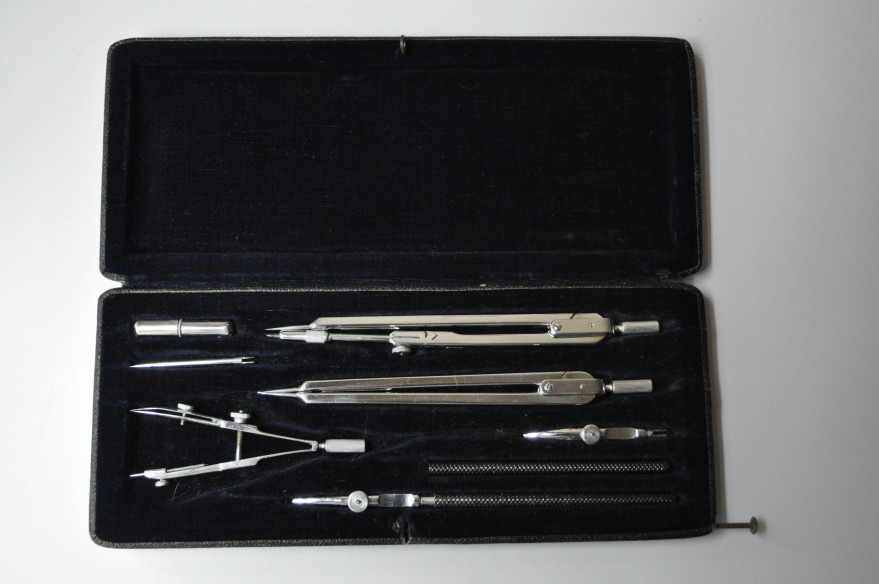
The Geometry Set


Sometime in the 1930s my father bought this – a draughtsman's set. After my parents were married it lived in the soft darkness – rarely-worn scarves, soft gloves – at the back of one of his wardrobe drawers. I'd occasionally see it when I was desperate and had left my brass compass at school (2/6 at the beginning of each school year because I had a gift for losing them), and had geometry for homework. I seem to remember he lent it to me the day I had to sit for a scholarship exam, when he also lent me his slim, brown, worked leather briefcase with sturdy wrap-around zip. I saw that a little more often than what I thought of as the geometry set, but not much more.

I won the scholarship (much to my shock). Mostly, I think, because he lent me these magical instruments.

Tuesday, May 10, 2011

The Black Swan

And so we finally saw The Black Swan. I didn't know much about it before watching it, and so I was surprised to see all the ancient tropes: the fragile virginal acolyte, the powerful impresario, the stage mother (only in the chorus, then pregnant), the role too hard to play, the self-slaughter at the moment of triumph...

It was The Turning Point and The Red Shoes, only worse. (There was no supportive company or converted composer, no jealous director / dramaturge. No one at all cheered for the woman in The Black Swan.) There was an amazingly cruel scene where the new principal dancer is introduced to the donors and supporters, pained and complex expressions and champagne on the staircase, while the former principal dancer is in the crowd on the floor below, a nobody, left to scurry off as best she can. (She's later run over by a car, sustains massive damage to her right leg, and cuts herself in the cheeks because she is & has nothing now.)

It was not White Nights. (Oh, that timid, wicked, commissar-loving Helen Mirren, that coward and inferior artist, that failure who failed to grasp the freedom embodied in the West!)*

The Black Swan definitely was not Tap. It wasn't anything with Ginger Rogers; it wasn't Singin' in the Rain or even bloody Yankee Doodle Dandy.

Art is dangerous for women, mostly, it seems, because men control it. Were any of the men in The Black Swan too virginal, too timid, too frigid? (Too unmanly, as you might have thought, but possibly not said, about Robert Helpmann?) Were the men's toenails splitting? Did the director sexually assault them to improve their performances? Were they declared unfuckable? No? And why not?

Arnofsky also directed The Wrestler. It could be argued he's just a misanthropist... But… The Wrestler kept reminding me of Lipstick and Dynamite, a documentary about women wrestlers in the U.S. in the '40s, '50s and early '60s – the punishing schedules, the drugs to keep you going, the cheating managers, the cheating spouses & partners, the virtual impossibility of working your way out of your contract –

Some of management's deceptions in L&D took me straight back to my time in boiler-rooms. So I thought The Wrestler was about class, not gender.

It might be that it's impossible to make a film about ballet that isn't about gender (the limitations of the f, the transcendence of the m.).

Just remind me never to watch another one. Ever.

---
* The character Galina was not an inferior artist: she was a peak performer of classical ballet. Classical ballet was becoming a thing of the past;  the Soviet Union was about to collapse.  Modern ballet, especially America modern ballet, was, in the movie, the dance of relevance, new horizons, the future - all packaged as "artistic growth." What of modern dance 25 years later, when America is on the verge of collapse? Is the Baryshnikov character now quaint and inferior, now that modern dance is becoming a thing of a particular era, emblematic of a future that leaked away into storms and sand? The plot prevented modern dance being presented as another choice, or something a classically-trained ballet dancer could continue to do with an aging body.

You can't separate the economic power of a milieu from the estimation of its arts...


Wednesday, April 27, 2011

Reading

Nemesis by Chalmers Johnson.

The great relief he gives comes in two flavours: things have indeed changed, changed utterly; he has a name for the disease, and it accounts for all the symptoms we see around us now. The disease is militarism (the worship of war and its weapons and accoutrements, its headlong destruction), and it has always been the deadly enemy of democracy.

And, as occasional relief from the austere comforts of Johnson, I am also reading The Red Queen*, by Phillipa Gregory. She's very good – and the covers of her Tudor novels have delicate lacework of red or silver foil tudor roses in a kind of Moorish arch across the top. They gleam when you tilt the book and the light glances off them. Whatever else falls, light still falls.

---
*Which is something of a tour de force. Gregory takes this vain, ambitious, cold, narrow woman – cabin'd, cribb'd and confin'd by her gender and circumstances, married off at 13 to Owen Tudor, half a country away, whose circumstances do not enlarge or gain in freedom until the Battle of Bosworth – and makes us see her. We pity her at times. Often, in fact. But in her cold, narrow, unlovely way, Margaret repels our pity. She is, finally, the mother of Henry VII and grandmother of Henry VIII - as far and overtly above our pity as she always thought she was.

Gregory is very good. And no slouch at power relations.

Sunday, April 24, 2011

The Karate Kid remake

11.13.10

The U.S. is now officially a client state. I saw it for a certainty when I watched The Karate Kid remake. Dre's mother had to go to China for a job.

That feeling of no bottom to my stomach was fear.

We've watched and lived through an epochal shift in geo-political power, and that moves the foundation of even an individual's identity.

You absorb the major power relations of the world as a cognitive and emotional foundation, a major indication of your place in it; and you do that when you're very, very young.

Wednesday, April 13, 2011

Why We Need Wikileaks - Pt. 2

Because Matt Taibbi has found the real budget, and we need to know about this steady, continual, corrosive looting of public wealth before the fact, not after.

Monday, April 4, 2011

A Weekend on the Couch: Balm for a Bad Back

The Bourne Identity – a man betrayed into redemption by his own unexpected, unsuspected compassion.

Michael Collins – a man who hates war and waste wages the first urban guerilla struggle, expels an occupying power from his country, and creates peace.

Red Cliff – An alliance of defenders defeats an invasion.

Ah... Integrity asserted, defended, discovered, maintained. Yes.